


Solving all disease is one of the most monumentally complex challenges in science. Today, for the first time, AI provides the foundation to make it achievable.
Tackling the frontier of human health is our mission, and it means identifying exactly where modern AI can make the greatest difference. We see drug discovery as the critical wedge in solving all disease, and therefore our initial focal point where AI can have a transformative impact on human health. Developing a drug that successfully and effectively treats disease fundamentally involves understanding biological mechanisms and designing exquisitely engineered molecules that can modulate them safely.
So we are taking a straight shot at making that a reality. We are generating the data, training the AI models, developing the software, and laying down the physical infrastructure to make new medicines; taking these potential therapeutics all the way to patients in the clinic. We are building this new architecture in a way that will scale across multiple disease areas, and different types of medicines, from small molecules to antibodies, peptides, and beyond.
In 2021, when we started Isomorphic Labs, AI drug discovery was just a hypothesis. Conventional approaches were bottlenecked by slow, resource-intensive iterative design-make-test cycles, viewing AI as an experimental tool for narrow tasks. At the same time the AI revolution was well underway across multiple industries. A seismic shift was happening with the emergence of foundation models, moving away from single-task algorithms toward highly versatile systems capable of world-understanding, zero-shot reasoning and generating complex text and images.
Up to this point, I had spent my education and career in core AI, building intelligent systems by scaling up neural networks and deep reinforcement learning to solve the hardest problems at a superhuman level. But having grown up in a medical family, I recognised the potential to apply this superhuman new technology to humanity’s most meaningful challenge: human health. Working with Sir Demis Hassabis, we created the founding team at Isomorphic Labs to pivot breakthroughs in AI toward solving the drug discovery problem. We set out on a path to approach drug discovery as an engineering process, stripping back to first principles, to rebuild the process to design medicines. Almost every field of engineering has been revolutionised at some point over the last 50 years by computer aided design, but I believe its transformational advancement in the making of medicines has only just begun. We saw a huge opportunity, using AI to fuel the computational methods that will turn this field into a more systematic engineering discipline, ultimately to bring life-changing medicines to patients that need them.
exquisitely engineered molecule
noun phraseex·quis·ite·ly en·gi·neered mol·e·cule
A chemical compound—typically a novel therapeutic drug—designed from scratch with extreme precision using advanced artificial intelligence to modulate a biological target to specification with minimal toxicity.
We are moving from empirical medicine toward exquisitely engineered molecules, and AI is the engine driving this shift. By stripping back to first principles, we are building AI to help us understand healthy and disease states at the molecular level. Subsequently we can leverage our superior predictive and generative capabilities to come up with a potentially exquisite molecular design that displays the best functional characteristics before it reaches patients.
Our approach:
Today, AI drug discovery is no longer a hypothesis. The mammoth contribution of AI in protein structure prediction was recognised with a Nobel Prize in 2024 for the work of AlphaFold 2. At Isomorphic Labs, we spent the last half decade building on this advancement and taking it further, creating the Isomorphic Labs Drug Design Engine (IsoDDE). IsoDDE goes beyond structure prediction, to a system with a suite of predictive capabilities that can accelerate the design and pre-clinical development of unique molecules. Our engine continues to exceed all existing deep-learning models and industry-standard computational methods for designing molecules to date. We have reshaped our drug design processes around this new predictive capability.
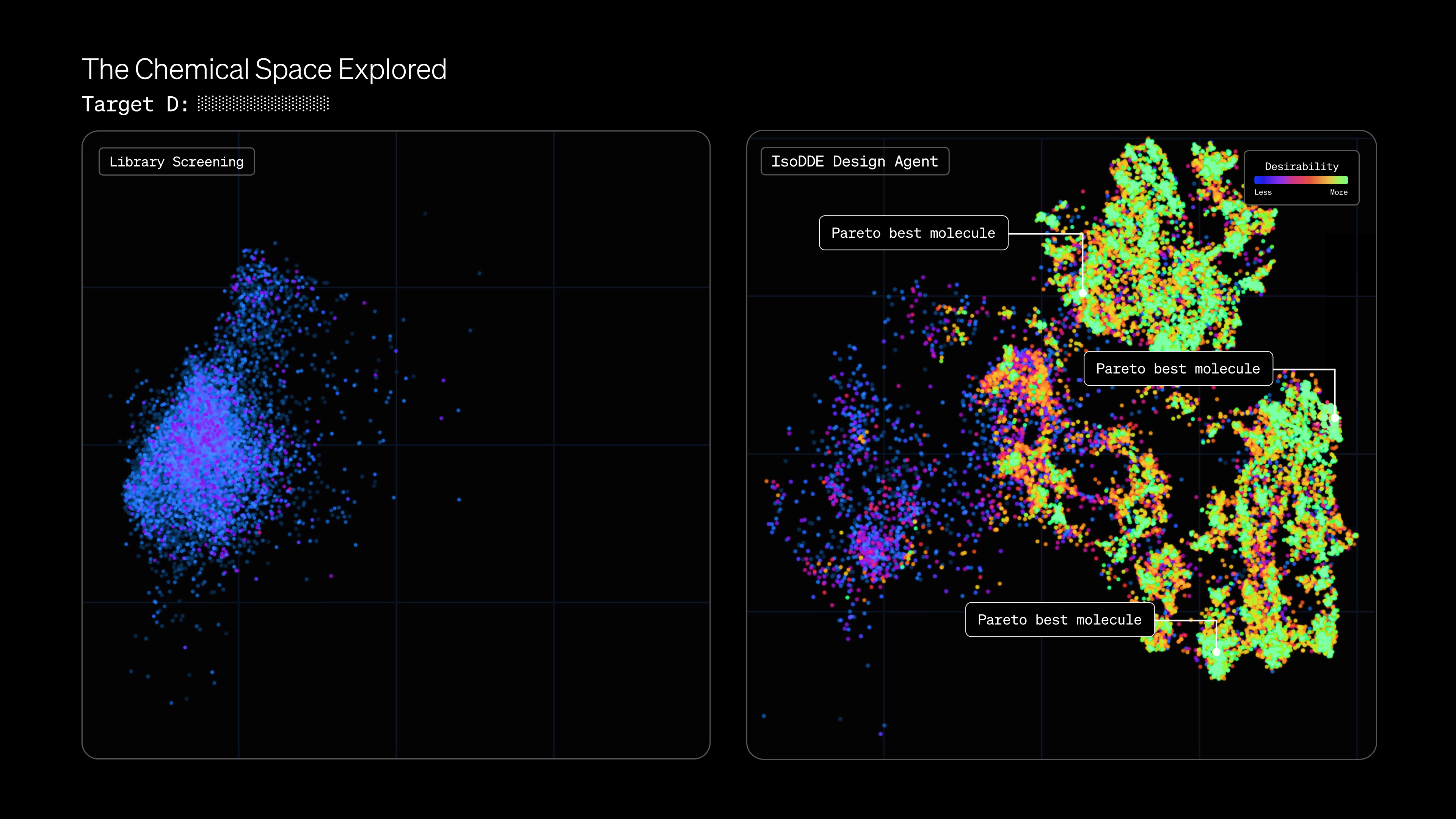
I want to zoom in to a core capability of our drug design engine: its ability to accelerate the design and optimisation of new drug candidates. The theoretical chemical space to search for small drug-like molecules is vast (people argue around 1060). Conventional experimental methods, like high-throughput library screening, can take months (even years) to evaluate fixed libraries of compounds (105-109) against proteins. To then optimise any initial hits into a clinical candidate involves a multi-year iterative search through chemical space, gradually improving and balancing the many properties required for a molecule to be ready for clinical trials.
In contrast, our drug design engine can intelligently search the chemical space in just a few days on a computer, designing functional molecules ready for the real world. I’m excited to share a snapshot of what that looks like.
The below videos are a representation of the progression of creating new molecule designs with the IsoDDE working autonomously over 2-4 days. Our drug designers input a design specification, a set of criteria and goals for what they want to create: the biological target, the type of molecule and mode of modulation, the required selectivity, and the desired properties of the molecule (e.g. solubility, cell permeability etc). Our design agent batch-iteratively generated molecules and searched the chemical space to improve desirability against our design specification. The green colour represents a desirable search: the greener the colour, the better the molecule.
This video zooms into Target D, illustrating a single search process, dramatically accelerating the path for hit molecule discovery. Traditionally, each step along this path requires 1–3 months of work – manually designing and making these molecules by teams of chemists, testing them by teams of biologists, and iteratively analysing the new data. Our AI drug design agent completes the same progression computationally in days by relying on our frontier AI predictive models rather than going directly to the lab. The agent’s process dynamically balances the exploration of vast, uncharted chemical space with the targeted exploitation of promising scaffolds in this open-ended learning problem. As the agent designs and evaluates candidates, it pushes the multi-objective pareto frontier, which is the optimal boundary where competing properties like potency and bioavailability are balanced. We can see the agent’s internal attention (represented as a heatmap) progress, shifting computational focus: broad attention during early exploration then narrows, to exploit and fine-tune the pareto frontier whilst still maintaining exploration.
At the end of the agent’s optimisation, we select multiple diverse compounds synthesis and then test the final designs to validate in the lab. The image below represents the functional concentration response curve from the real world experimental testing of the output of the molecular search process above, with a literature-derived molecule for reference (estimated result of 3-5 years of work from authors). The experimental curve shows the agent-designed molecule successfully modulates the biological target with good properties, which is a great starting point for designing a potential therapeutic.
.png)
What we show above is one example of dozens. From our experience of applying IsoDDE to many problems to date, we have seen we are able to find functional molecules for problems with which others have greatly struggled. We can do so with less real-world lab time, and in novel chemical spaces that have the potential for exquisite properties, and modulating biological mechanisms, those that have never been tried or proven before. Instead of testing thousands to millions of molecules in the real world, we can synthesise just a handful of molecules and get better experimental results. The capabilities from IsoDDE allow us to not only create scientific hypotheses of new molecules, but to do a lot of predictive validation, so that when we do test our hypotheses in the lab they have a much higher chance of success.
Isomorphic Labs started in a one-room office, with a deeply held hypothesis and a handful of the world’s most talented scientists and engineers. At the beginning, our first scientific breakthroughs on our drug discovery programs came slowly. Over the last five years, we’ve worked relentlessly to increase the accuracy and breadth of capabilities, and as a result, the rate of scientific breakthroughs has drastically increased. Using the IsoDDE we’ve uncovered new biological mechanisms, designed molecules that open previously unknown pockets, and have validated wet lab results demonstrating unique biological functionality. Our hypothesis has been proven. Our preclinical data is helping us to gear up for clinical developments. We are pushing with full force to deliver the impact that AI-driven drug design can achieve for patients, to make discovery and development less like magic and more like precise, repeatable engineering. There is no greater privilege than to work on solving this problem, and we are laser-focussed on bringing these results to the people who need them most.